Sonntag, 23. August 2015

Staffpad: writing scores by hand and transform them into MIDI


Staffpad: writing scores by hand and transform them into MIDI


Staffpad is a new application developed by Microsoft and the dream come true of every composer and arranger. It is a music notation application designed to work with pen and touch input your Windows 8.1 compatible device and touch screen.


When writing with pencil notation, StaffPad recognizes your handwritten music and becomes a notation that you can edit, play, print and share in various formats, combining the best of writing on paper with the advantages of digital publishing.Staffpad was designed by Matthew Tesch and David William Hearn, who."As musicians, we know that is not always practical or possible to lead a workstation complete recipe with you. Instead, the idea of ​​combining the fluidity and ease of handwritten with efficiency and accuracy of typesetting, assisted by a computer, music became too strong to ignore. We found the experience StaffPad composition should feel natural, fun and intuitive, yet powerful and reliable enough for it to be used by professionals. We have been working for over 3 years to bring StaffPad, with new ideas and advances to a new type of application notation, focusing on every detail so that the composition StaffPad is done with the least possible effort. "In addition to handwriting, Staffpad offers a variety of sounds in your bank of musical instruments, the ability to print both the full score as particella of each instrument, editing notes and joints and the enormous advantage of import and export MIDI files and MusicXML format. What more could you want?For more information on cost, features, compatibility, and download, go to the page StaffPad.


Mittwoch, 12. August 2015

Someone made a piano in the shape of a classic Nintendo console and played Mario music on it

Is there a better way to use technology than turning a piano into a huge retro NES console and then playing a medley of Koji Kondo superhits on it? No. No there is not.
image: http://assets3.classicfm.com/2015/31/nintendo-piano-1438962331-article-0.jpg
nintendo piano
The piano is the brainchild of the YouTube channel Player Piano, who got pianist Sonya Belousova to play a medley of tunes from the soundtrack of Nintendo classic Super Mario Bros.

Right, let’s take a tour of this pianistic wonder of the gaming world, shall we?


First of all, it’s even got the right cables
Red and yellow is the colour of nostalgia.
image: http://i.imgur.com/RpuoaHo.png

The piano stool is a NES controller

It couldn’t be anything else, could it?
image: http://i.imgur.com/Vjm3OHO.png

There are POWER and RESET buttons on the front

The detail is sending our nerd receptors into overdrive.
image: http://i.imgur.com/G58r6is.png

And then, the ultimate cartridge console-based nod to the past

Nothing worse than a dusty cartridge. *cries tears of ecstasy*
image: http://i.imgur.com/BUM1FWA.gif

Watch the whole glorious thing here: 

Read more at http://www.classicfm.com/discover/video-game-music/nintendo-piano/#zLeRszw5fi0OsIdT.99


Montag, 10. August 2015

Today 150 years ago, born Alexander Glazunov  in St Petersburg Russia. (10 August 1865 - 21 March 1936)


Alexander Glazunov was born into a wealthy family and began very early to deal with music. This fell on especially his amazing musical memory and his excellent hearing. 1880 Glazunov began on the recommendation of Mily Balakirev a private study with Nikolai Rimsky-Korsakov, who was impressed by the talent of his pupil. The first performance of Glazunov's Symphony no. 1 in 1882 was the breakthrough for the young composer. Under the leadership of Rimsky-Korsakov's opera he completed Borodin's Prince Igor. He also became acquainted with the patron Mitrofan Belyayev, who supported him in the following years. After Glazunov was promoted in the 1890s to an internationally recognized personality, he took in 1899 a professor of orchestration at the St Petersburg Conservatory. In 1905 he took over as head of this institute, which he held until 1930. In February 1910, he took on Six Piano Pieces for the Welte-Mignon reproducing piano. During this time took his compositional productivity, due to the time required and its unique commitment to the interests of this institution, significantly. He discovered many talents and worked tirelessly for a student. 1928 Glazunov traveled to Vienna, where he participated as a jury member at the International Schubert Competition. His poor health did not allow him to return so that he settled in Paris. Here he remained until his death. 1972 his remains were (again today St. Petersburg) was transferred to Leningrad and buried in the Alexander Nevsky Lavra.
The ship Kompozitor Glazunov was named after him.

Violin Concerto


Piano Concerto


 Concerto in Eb Major, Alto Saxophone

 Piano sonata Nr. 2 E minor Op. 75


Sonntag, 9. August 2015

The First SLA 3D Printed Electric Violin is Here! It’s Amazing & It’s Clear!

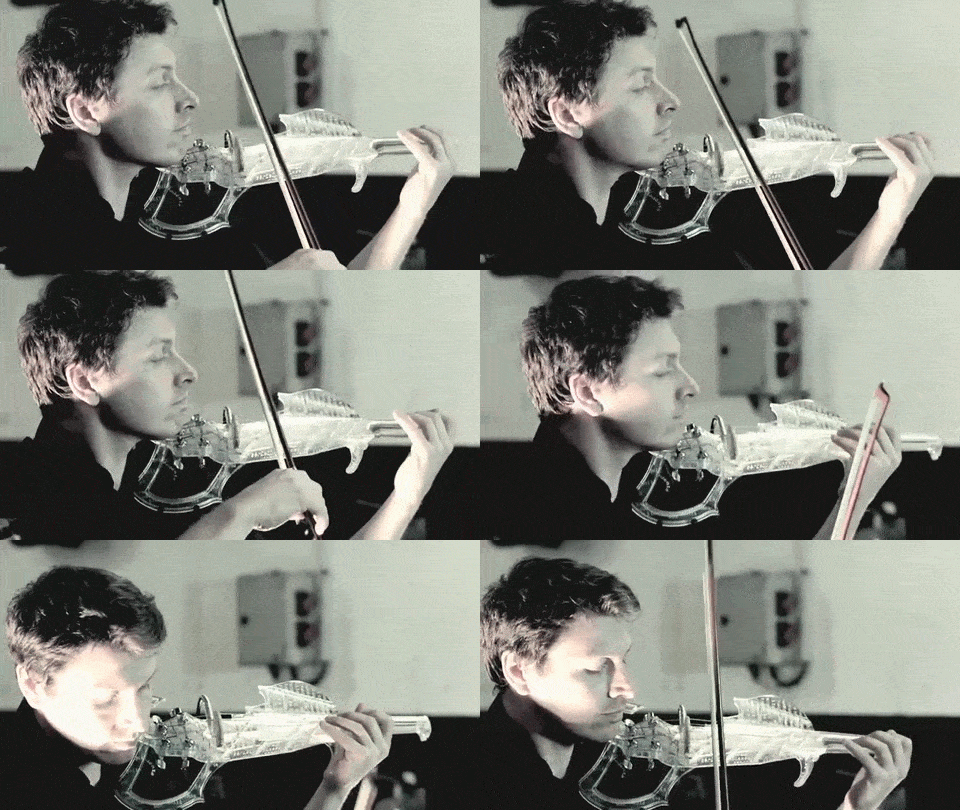
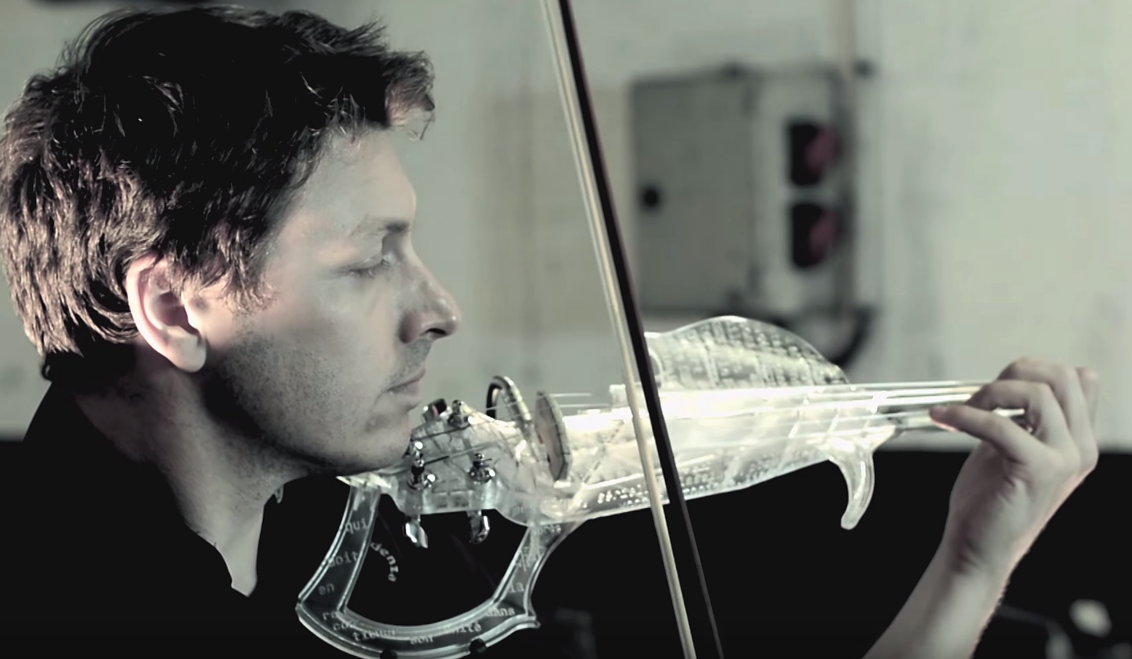
violinaniOver the past year or so, we have really begun to see musicians and designers utilizing 3D printing technology in order to create unique, custom, and incredibly sounding musical instruments. We’ve seen everything from guitars to cellos, flutes and violins all fabricated on 3D printers of all kinds. Most of these instruments have been created either on FDM/FFF based 3D printers similar to those found on many of our desktops at home, or large industrial level selective laser sintering (SLS)machines. Now, however, one musician, named Laurent Bernadac had taken things up another notch. Laurent Bernadac, you see, has taken it upon himself to create a fully playable electric violin which has been printed using stereolithographic (SLA) technology. This has allowed him to create one of the most astonishing violins you will ever see.
Called the 3D Varius, not only does it play crystal clear music, but its bout (body), neck and the majority of the rest of the instrument is 3D printed in a clear material as well.
“The goal was to create a unique design, inspired by the shape of a traditional violin, and refining the forms and supports to obtain a more aesthetic design, simpler, lighter and transparent,” Bernadac explains. “Our choice of 3d-printing technology is stereolithography* because of its exceptional printing definition and the resistance of its printed objects.”

Bernadac’s design is actually based on a Stradivarius violin; a violin which was built by members of the Stradivari family during the 17th and 18th centuries. It is 3D printed in one single piece, which strays quite a bit from traditional violin production, using UV light to cure a liquid photo-reactive resin. This method of 3D printing builds up highly detailed and precise objects in a matter of hours.
violin1
“Combining the precision and power of 3D-printing with ancient violin-making skills, its innovative design, in the service of violinist, marks a further step towards the perfect symbiosis between musician and instrument,” Bernadac explains.

Once the violin was 3D printed, it required a quick clean-up before being put under a strong UV light in order to completely polymerize the entire structure. This ensures that it is completely cured and as strong as can be. Then the surfaces of the violin, which comes into contact with the strings or the musician’s body, are sanded down in order to “offer optimal playing comfort”. It’s then off to stringing the instrument, a process which must be done with complete precision and care in order to ensure that it plays with the clarity it is capable of. violin3
While Bernadac says that the violin is fully 3D printed, in actuality it isn’t entirely fabricated on a 3D printer, as of course the strings are not 3D printed, nor are the tuning pegs. However, the majority the instrument in fact is.
As you can hear in the videos on this page, the violin’s sound is as crystal clear as the instrument itself. Could SLA 3D printing prove to be the preferred printing method for 3D printing musical instruments? Bernadac’s 3D Varius may prove this to be true. What do you think about this unique, yet beautiful 3D printed violin? Discuss in the 3D Varius forum thread on 3DPB.com.


violin2

Donnerstag, 9. Juli 2015

Violinist Kevin Yu Invents a High-Tech Tux Shirt

Laurie Niles
Written by
Published: July 7, 2015 
Why shouldn't symphony musicians have high-tech apparel, just like athletes do? After all, playing the violin or any other instrument certainly requires a degree of sweat and athleticism. The need for such gear is more acute for men, who usually have to wear restrictive tux shirts and jackets when playing a classical concert.
This is the issue that led violinist and businessman Kevin Yu to found a company called Coregami, with the stated mission of designing the perfect concertwear for musicians. In June they introduced their first product to the world: a tux shirt. I talked with Kevin about what inspired his company and about what makes this tux shirt different from others.
Kevin Yu
Laurie: What is your background, as a violinist?
Kevin: I have studied with Michael Selman (Joseph Silverstein student), Vincent Frittelli (Galamian student), and Emmanuel Borok (former concertmaster of the Dallas Symphony).
To my knowledge, I am the only person in the world who has declined music school on three separate occasions after gaining admissions (University of Michigan in undergrad, Northwestern University’s Masters Program, and SMU’s Artist Diploma program). Despite not having attended music school, I have served as the Principal of the Masters Sinfonia (in California) and have served as the Principal of the Las Colinas Symphony Orchestra (Irving, Texas).
We were immigrants from Singapore. Crushing it in the classroom, being a teacher’s pet, and playing an instrument were basic expectations. But then I fell in love. Music was the only thing that could calm me down. Accolades and medals were followed by big scholarships to all the universities. Doing what you love is like getting a high-five for eating ice cream.
My dual-focused career path started the moment I was accepted into the undergraduate business program. As soon as I had landed at University of Texas - Austin, I got a phone call from the violin professor who took me under his wings. I was a student by day and an intern at a tech startup by night. During my freshmen year, I became the concertmaster of the university orchestra and started getting calls to play with local symphonies. Although I didn’t attend music school, my professional resume was stacked before I turned legal.
Laurie: What inspired you to want to make the perfect tux shirt?
Kevin: There are three reasons: Personal frustration, lack of options in the formal wear category, and an abundance of options in other fashion categories.
It’s true what they say – frustration is the mother of invention. I got frustrated when I couldn’t find the right tuxedo shirt. For more room, I always had to buy a size too big. And then I felt robbed, each time I paid a tailor to rig a shirt that was never designed for mobility.
The idea of Coregami was conceived on the running trail. At the end of each run, I’m usually drenched from heat to toe. As I was cooling down one morning, I took a closer look at my Under Armour running shirt. It was stretchy, moisture-wicking, and light as air. I thought to myself, “Why can’t I be this comfortable while I’m on stage?” While backstage before a show, I began to float the idea of an athletic version of a tuxedo shirt. Just about every guy raised his eyebrow with a smile. Their response gave me the courage to take the next step.
Laurie: How, and who, did you find to design this?
Kevin: It was a long journey because I started at zero. I didn’t know the first thing about the fashion industry, much less how to design an article of clothing. But having worn formal wear for 30 years, I do have a clear understanding of what is comfortable and suitable to honor the occasion.
It was uphill from day one. Selecting the right type of fabric felt like playing the lottery. But through a lot of research and meetings in Los Angeles, we were able to procure some really special materials from a world leader in the sports wear category. They took an active interest in our mission and continue to serve as a great partner and advisor.
When we first started, everyone from the production team, pattern makers, and designers wanted to do things the old way. We came out with some really awful prototypes in the early days.
The one thing that really helped us was that we always included the music community into our development process. We iterated through many prototypes and failed our way to a solution. Before long, we had our first minimally viable product.
Laurie: What exactly have you come up with, in men’s concert wear?
tux full viewKevin: Coregami’s first product (The Gershwin) is the first tuxedo shirt in the world that is designed for musicians, by musicians using the principles of high performance athletic wear. It is made from advanced fabric that is moisture-wicking, four-way stretch, and anti-odor. With an ergonomic open shoulder pattern, seamless stitching, and lighter fabric, our testers call this “the best tuxedo shirt ever designed."
Laurie: What, very specifically, makes these shirts different from the typical tux shirts?
Kevin: Formal wear was conceived in the last century and was never intended for active movement. With the desire to incorporate modern athletic concepts, we knew we had to take a different approach. Through rounds of testing with some of the most elite musicians in the United States, we failed our way to a solution.

We are proud to say that these features have never been seen on any formal wear products in history:
  • Fabric: No more cotton or cheap polyester. The Gershwin uses an advance fabric that has four-way stretch, moisture-wicking, and anti-odor capabilities.
  • New Pattern: The old shirt patterns have stitches that intersect right where we require the most amount of movement … at the shoulders. We researched shirts used by professional golfers and came up with the “Open Shoulder” design to increase range of motion.
  • Cuffs: French cuffs look nice, but musicians often complain about the weight and unnecessary bulk. Cellists complained about the cuff links and accessories hitting their expensive instruments. We moved to single cuffs to reduce bulk.
  • Seamless stitching: To reduce chaffing
  • Softest pleats: With new fabric, there is no more stiffness on your front pleats
  • Low Maintenance: Professional musicians play 3 – 4 concerts, 20 – 40 weeks a year. With advanced fabrics, say goodbye to expensive dry cleaning. Simply wash and hang dry.
Laurie: Have you tried playing in the new gear, and is it a different experience? In what way? Any surprises about how it feels?
Kevin: Yes – it is a drastically different experience. The comment that we hear the most is that it is extremely light and breathable because they no longer have to wear an undershirt. The trifecta of formality, comfort, and high performance has never come together – until now. We had addressed much of the performance issues before we released the product to the public in June 2015.
tux shirt, back view